

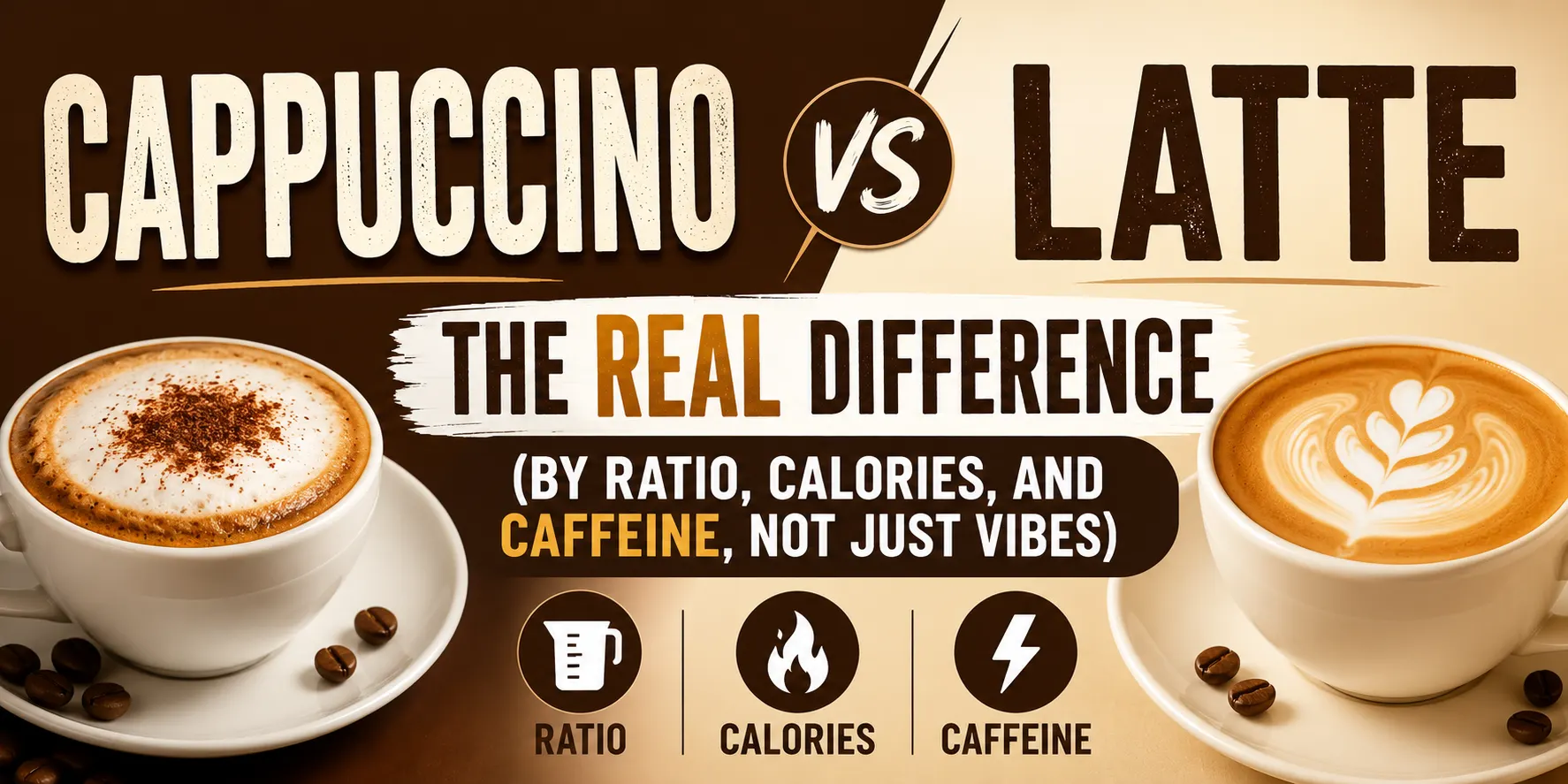
Quick answer: Both start with the same shot of espresso. A cappuccino adds a small amount of steamed milk and a thick cap of foam, so it’s smaller, more textured, and tastes stronger. A latte adds much more steamed milk and only a thin layer of foam, so it’s bigger, silkier, and milder. Caffeine is identical for the same shot count — the difference is milk volume and texture, not strength.
Most articles comparing these two drinks stop at “cappuccino has more foam, latte has more milk” and call it done. That’s true, but it doesn’t tell you which one to actually order, why your cappuccino tastes different at every café, or why a “large cappuccino” sometimes has fewer calories than a “small latte.” This guide covers the ratios baristas actually use, the calorie and caffeine numbers by size, and a decision framework so you stop guessing at the counter.
The One-Sentence Difference
A cappuccino is roughly equal parts espresso, steamed milk, and milk foam. A latte is one part espresso to about four or five parts steamed milk, topped with a thin skin of foam. Same espresso, different milk math.
Cappuccino vs Latte: Side-by-Side Comparison
| Attribute | Cappuccino | Latte |
|---|---|---|
| Origin | Italy, named for the Capuchin friars’ brown robes | Italy, “latte” simply means milk |
| Typical ratio | 1:1:1 espresso, steamed milk, foam | 1:4–5 espresso to steamed milk |
| Foam depth | Thick, roughly 1 cm or more | Thin, a few millimeters |
| Standard size | 5–6 oz traditional; 8–12 oz at most US cafés | 8–20 oz, often served larger |
| Texture | Light, airy, dense foam on top | Smooth, silky, pourable |
| Flavor | Bolder, more espresso-forward | Milder, sweeter from more milk |
| Caffeine (same shot count) | Same as latte | Same as cappuccino |
| Calories, 12 oz, whole milk | ~120–140 | ~190–210 |
| Best for | Strong-coffee drinkers, smaller portions | Milk lovers, all-day sipping, flavored syrups |
What Actually Makes a Cappuccino a Cappuccino
A traditional Italian cappuccino is built in three distinct layers: a shot of espresso at the bottom, a small pour of steamed milk, and a generous cap of microfoam on top — thick enough that a spoon can rest on it. The foam isn’t decorative; it slows how fast you drink the espresso underneath, which is why cappuccino is traditionally a morning drink in Italy, meant to be sipped slowly rather than gulped.
In the US, “cappuccino” often stretches to mean any foam-heavy espresso drink, including larger 12–16 oz versions that would raise eyebrows in Rome. If you want the classic version, ask for a “traditional” or “dry” cappuccino.
What Actually Makes a Latte a Latte
A latte swaps foam for volume. Baristas steam a larger quantity of milk to a silky, barely-there froth, pour it into the espresso, and finish with a thin foam layer — sometimes shaped into latte art. Because milk dominates the cup, a latte is the drink most flavored syrups (vanilla, caramel, pumpkin spice) are built on, since the extra milk volume carries sweetness without drowning the espresso completely.
Also Read: Masago: what it is, what it tastes like, and how to buy the good stuff
Taste and Texture: Why They Feel So Different in Your Mouth
Steamed milk and foamed milk are the same milk at different air-to-liquid ratios, and that ratio changes how a drink feels. A cappuccino’s dense foam creates a lighter, almost dry mouthfeel up front, followed by a hit of concentrated espresso as you drink through the foam. A latte’s higher liquid-milk content gives it a heavier, creamier mouthfeel from the first sip, and the espresso flavor is diluted more evenly throughout rather than front-loaded.
This is also why a cappuccino tastes “stronger” even though the espresso shot is identical: less milk means less dilution, so the same amount of coffee compound hits your palate in a smaller volume of liquid.
Calories and Nutrition: The Numbers Cafés Don’t Print on the Menu
Calories in either drink come almost entirely from the milk, since a shot of straight espresso is close to calorie-free. That means size and milk type matter far more than which drink you order.
| Drink (12 oz / tall) | Whole milk | 2% milk | Oat milk | Skim milk |
|---|---|---|---|---|
| Cappuccino | ~130 cal | ~100 cal | ~110 cal | ~70 cal |
| Latte | ~200 cal | ~150 cal | ~170 cal | ~120 cal |
Figures are approximate averages across major US chains and will vary by exact recipe, shot count, and syrup add-ins. Always check the specific café’s nutrition info for a precise count.
Practical takeaway: if you’re watching calories but don’t want to give up your milk-forward drink, a cappuccino in your usual size will typically save 60–80 calories over a latte, simply because it uses roughly half the milk.
Caffeine: The Part Everyone Gets Wrong
Cappuccino and latte have the same caffeine content when made with the same number of espresso shots. A single shot is roughly 63–75 mg of caffeine; a double is roughly 125–150 mg. Milk contains no caffeine, so adding more or less of it doesn’t change the total — it only changes concentration and taste.
The confusion comes from cafés that default to different shot counts by size: a small cappuccino might get one shot while a large latte automatically gets two, making the latte feel “stronger” in caffeine even though drink-for-drink at equal shot counts, they’re identical.
How to Make Each One at Home
Cappuccino
- Pull a single or double shot of espresso into a small (5–6 oz) cup.
- Steam roughly 2–3 oz of milk to about 150°F, aerating heavily for thick foam.
- Pour steamed milk first, then spoon the foam on top so it holds its shape.
Latte
- Pull a single or double shot of espresso into a larger (8–12 oz) cup.
- Steam 6–10 oz of milk to about 140–150°F with minimal aeration for a silky microfoam.
- Pour the milk in a steady stream, holding back the last bit of foam to finish the top.
No espresso machine? A stovetop moka pot plus a handheld milk frother gets you close to both drinks at home for a fraction of café prices.
Which One Should You Actually Order?
| If you… | Order a… |
|---|---|
| Want the strongest coffee flavor in the smallest cup | Cappuccino |
| Prefer a smooth, mellow, all-day sipping drink | Latte |
| Are cutting calories but still want milk | Cappuccino |
| Love flavored syrups (vanilla, caramel, seasonal) | Latte |
| Are new to espresso drinks | Latte |
| Want something between the two | Flat white or “wet” cappuccino |
Also Read: What to Eat, What to Eat: A Simple Way to Decide When Nothing Sounds Good
Nearby Drinks Worth Knowing
Flat white: Less milk than a latte, thinner foam than a cappuccino — a middle-ground drink that’s grown fast in US cafés over the past decade.
Macchiato: Espresso “marked” with just a dollop of foam, far more espresso-forward than either cappuccino or latte.
Cortado: Equal parts espresso and steamed milk with almost no foam, common in Spanish and Latin American coffee culture.
The Bottom Line
Cappuccino and latte aren’t different strengths of the same drink — they’re different milk-to-foam ratios built on an identical espresso base. Choose cappuccino for a smaller, bolder, lower-calorie cup, or latte for a bigger, milkier, more customizable one. Once you know the ratio behind each name, ordering confidently at any café stops being a guessing game.
Calorie and caffeine figures are general estimates based on standard recipes and commonly published nutrition data; exact values vary by café, milk type, shot count, and cup size.
Frequently Asked Questions
Is a cappuccino stronger than a latte?
Caffeine-wise, no — they’re the same with equal shot counts. Flavor-wise, yes, because a cappuccino has less milk diluting the espresso.
Which has fewer calories, cappuccino or latte?
Cappuccino, typically by 60–80 calories at the same size, since it uses roughly half the milk of a latte.
Can I substitute a cappuccino for a latte?
Yes, but expect a smaller, foamier, more espresso-forward drink. Ask for a “wet cappuccino” if you want more steamed milk and less foam while keeping the cappuccino base.
What’s the difference between a latte and a flat white?
A flat white uses less milk than a latte with a thinner, more tightly steamed layer, landing between a cappuccino and a latte in strength.
Is cappuccino or latte better for beginners?
Latte, generally — the higher milk ratio softens espresso’s bitterness and acidity, making it a gentler entry point.